NEW ORLEANS RESTAURANT REVIEW: Dakar NOLA
I've been to New Orleans almost more times than I can count, for bachelor parties, conferences, and miscellaneous debauchery. It's truly one of the most singular and incredible cities in the country, and it's only a short one-hour flight from Houston (or a six hour drive if you are a madman who prefers road trips, which I am not). Over the past two decades I feel like I've experienced just about everything that the Big Easy has to offer, from blackjack at Harrah's (now Caesar's apparently), to brews at Avenue Pub, to gator-seeking swamp tours, and even consuming j*zz on Frenchmen Street (censored because the thought of doing this again is so revolting that I can't bear to type it out... I know some people are into it, but just the thought of seeing another trombone, rusty or otherwise, makes me want to vomit). These days, however, now that I'm regretfully too old for syringe shots at Razzoo on Bourbon Street (the best club in the world, bar none), my preferred activity is exploring the city's culinary scene.
New Orleans might have the highest number of amazing eateries per capita of any town in America; there's incredible Cajun and Creole food seemingly everywhere you look. Legendary Garden District spot Commander's Palace has long been a favorite of mine, as has the more modern GW Fins. There's world-class fried chicken at Willie Mae's and god-tier po' boys at Parkway. But it's not just Louisiana cuisine: we sampled some wonderful Indian fare at LUFU (including tandoori pineapple!) and pho at Singleton's Deli this time around. However, even I was not expecting to find a great Senegalese restaurant (I Never Took The Time to learn about that nation's food; my experience consists solely when I Tried maafe once).
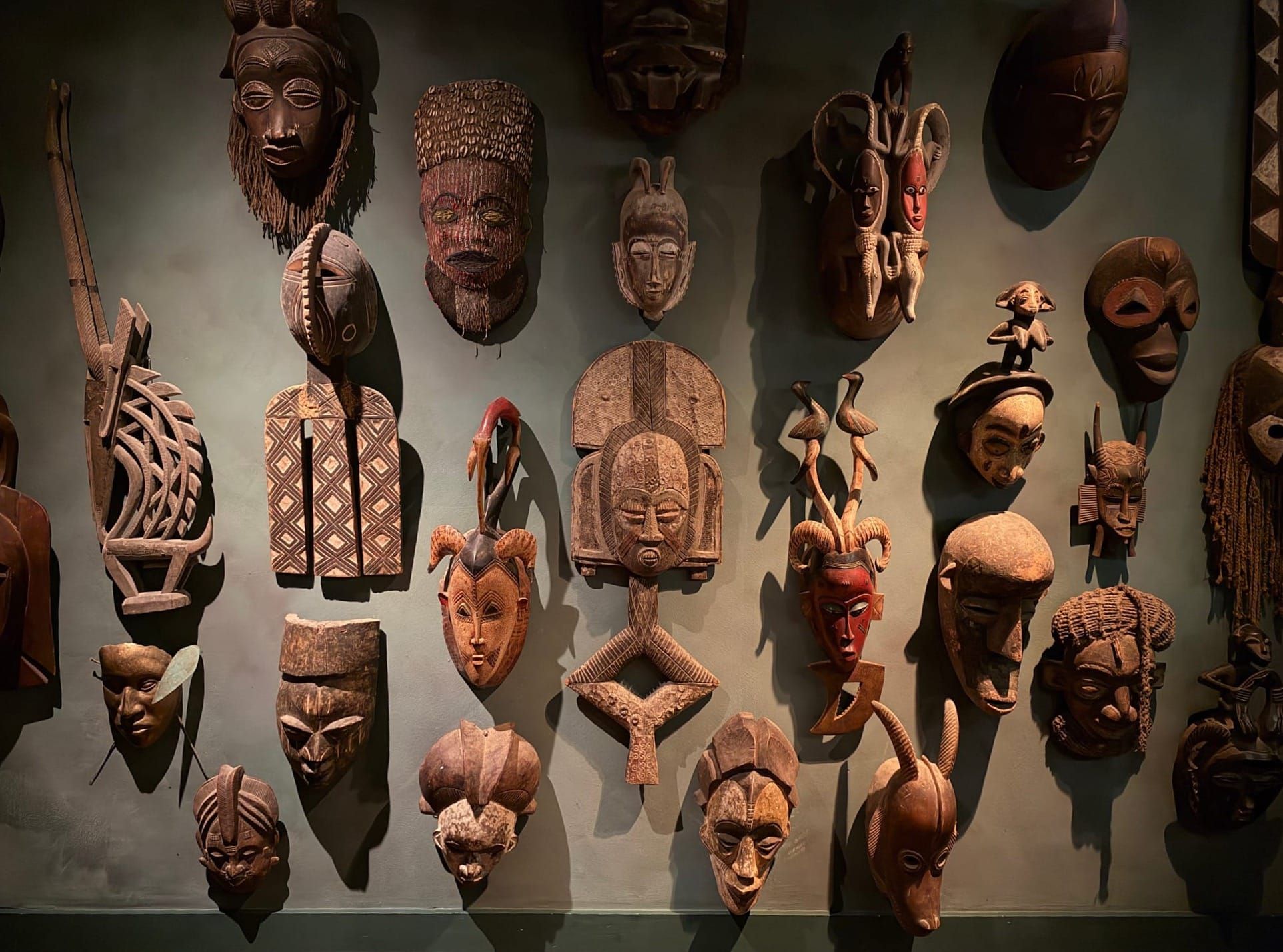
Dakar NOLA (which ranked a stunning #4 on The 50 Best Restaurants in North America list earlier this year), from chef Serigne Mbaye, originally opened on Magazine Street in 2022, but recently moved west, to a modest cottage in the middle of a neighborhood near the Mississippi River levee. A small hallway with the host stand separates the outdoor patio and the diminutive dining room, painted a forest-y green and opening up to the pass, with the kitchen visible beyond. We were sat at the premier table, under a wall of ornately carved African masks, seen in the header photo above, as there was no exterior signage for me to photograph.
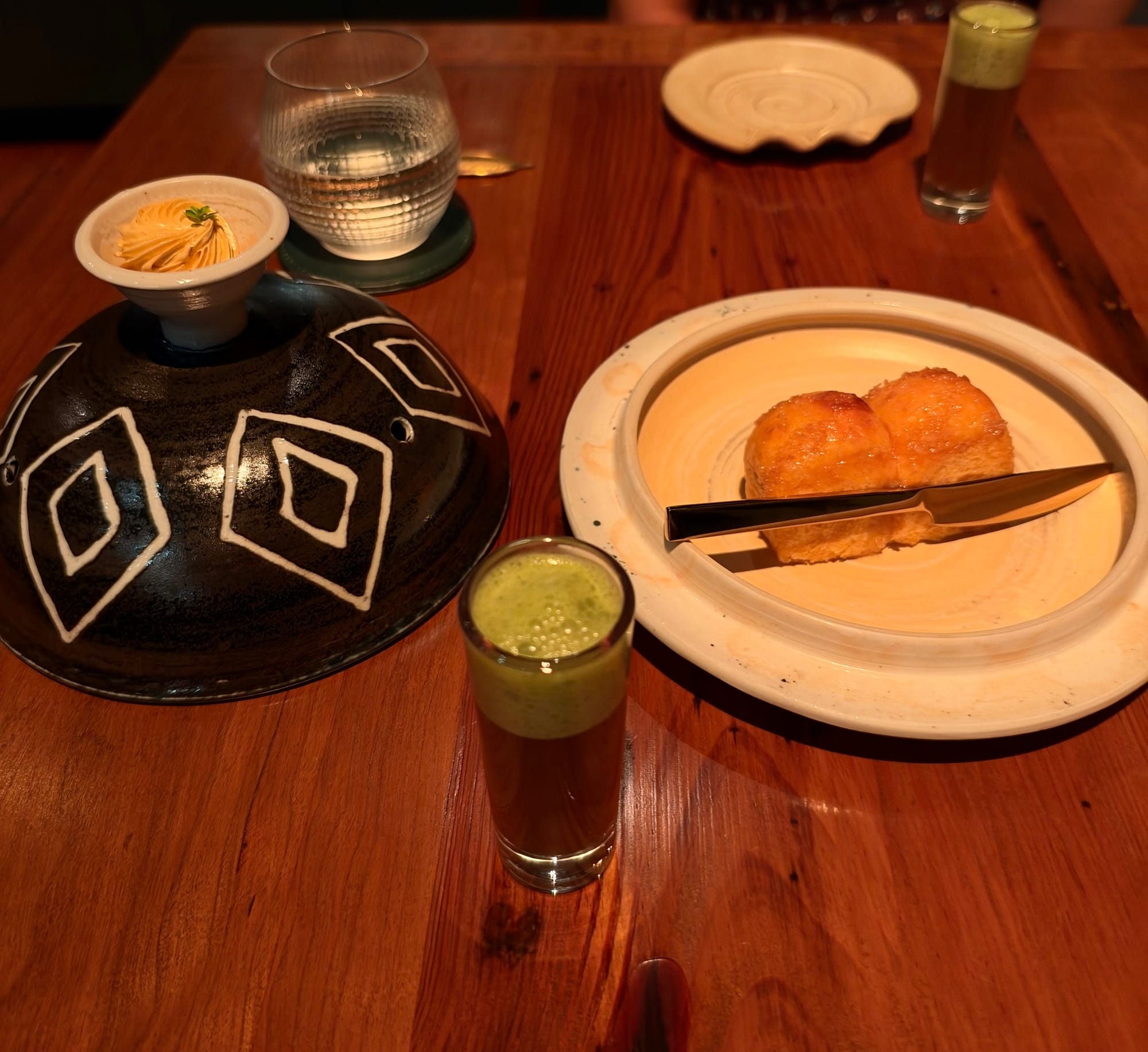
Your evening begins with a traditional Senegalese hand washing ceremony, via a Beautiful custom handmade cart brought to the table side. Warm water is poured from a pitcher over the guest's hands into a basin, an example of the national hospitality culture called teranga. Another exemplification is Ataya, an elaborate tea ceremony classically involving Chinese gunpowder tea slowly prepared in three separate stages. Here it was "evolved and in miniature", taking the form of a shot glass with a ginger-turmeric brew and a mint foam topper. I am historically a huge advocate for coffee's better, more sophisticated cousin, and this was a lovely, unique variation that I'd not tried before.
Ataya was one half of the first course (officially there are seven, but as is often the case with these types of tasting menus, the actual number really Don't Matter, as it's more of a baseline that is supplemented with bonus dishes here and there), paired with Dakar Bread. This monkey bread-esque roll featured west African palm fruit oil and was accompanied by habanero spiced butter. Sweet and fluffy, you couldn't ask for better bread than this, especially when augmented by the kick of a big ol' swipe of butter.
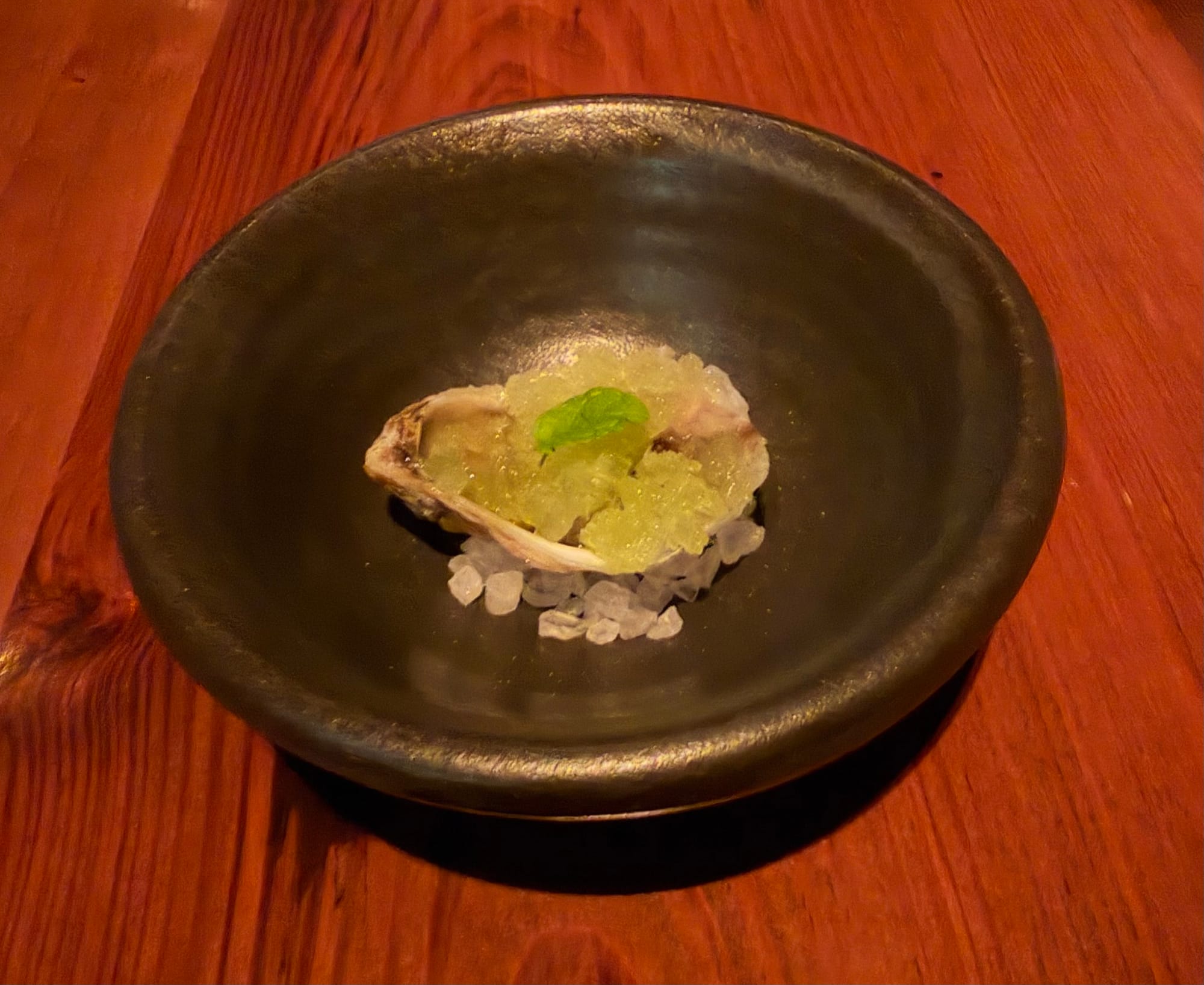
A non-numbered intermezzo course (a "gift from the kitchen", which is always nice) was a raw Oyster with shrimp paste. I don't usually do uncooked bivalves, as I have seen what Vibrio vulnificus does to people, but I faced my fears and actually kind of enjoyed the brackish, pungent combination, though that slimy texture is still not the most pleasant thing in the world.
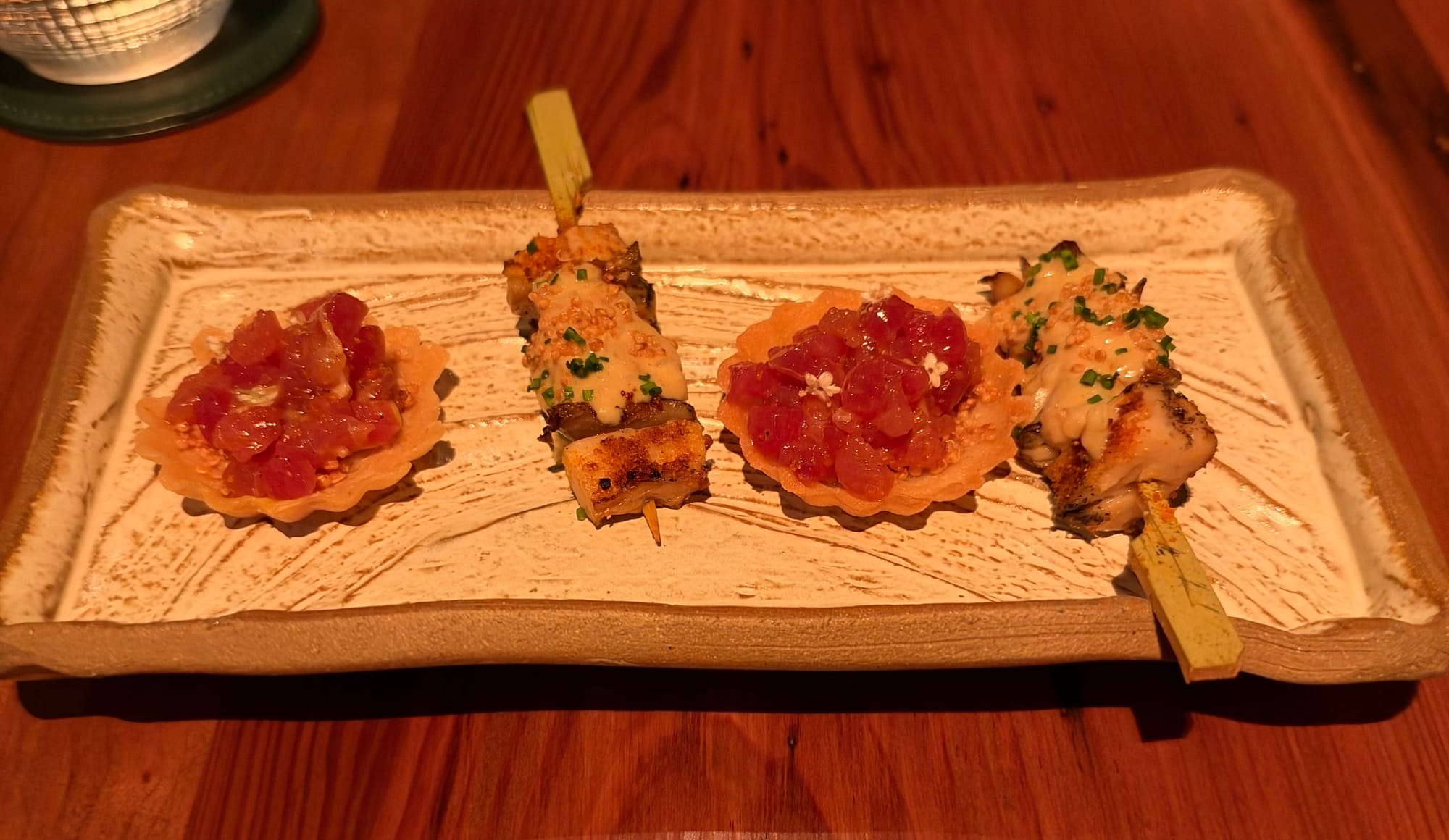
Another bipartite course came next, one half of which was Dibi. Normally a term for Senegal's iconic street food of wood-fired meats, this was a meatless homage to those flavors showcasing grilled oyster and lion's mane mushrooms on a stick with suya spice, mustard sauce, and puffed-fried quinoa. This is a second consecutive food I normally refuse to touch, but I bit the bullet and went for it, and, wouldn't you know it, the fungus wasn't half bad. Still texturally not my cup of ataya (callback, get it?), this was at least drenched in an incredible sharp and spicy condiment that I would love to have in a bottle to add to everything from burgers to fried chicken (or, like, some foods that are not stereotypically American as well).
On the same plate as the above came Gulf Fish & Pataas (a word which I'm unable to find a definition for, as I'm assuming it does not refer to a 2015 Indian Telugu-language action comedy film as Google indicates), which were canapés with small chunks of suya spice-marinated Yellowfin tuna atop acorn squash crackers. I'm starting to think that suya should just be used in all cuisines, as it is just the pinnacle of spice mixes (though I may have said the same thing about berbere when I last had Ethiopian food) with its peanut-based, fiery, aromatic flavors. Not the best for people with allergies to that particular legume, sure, but that's what EpiPens are for (looking at you, Brian Vial).
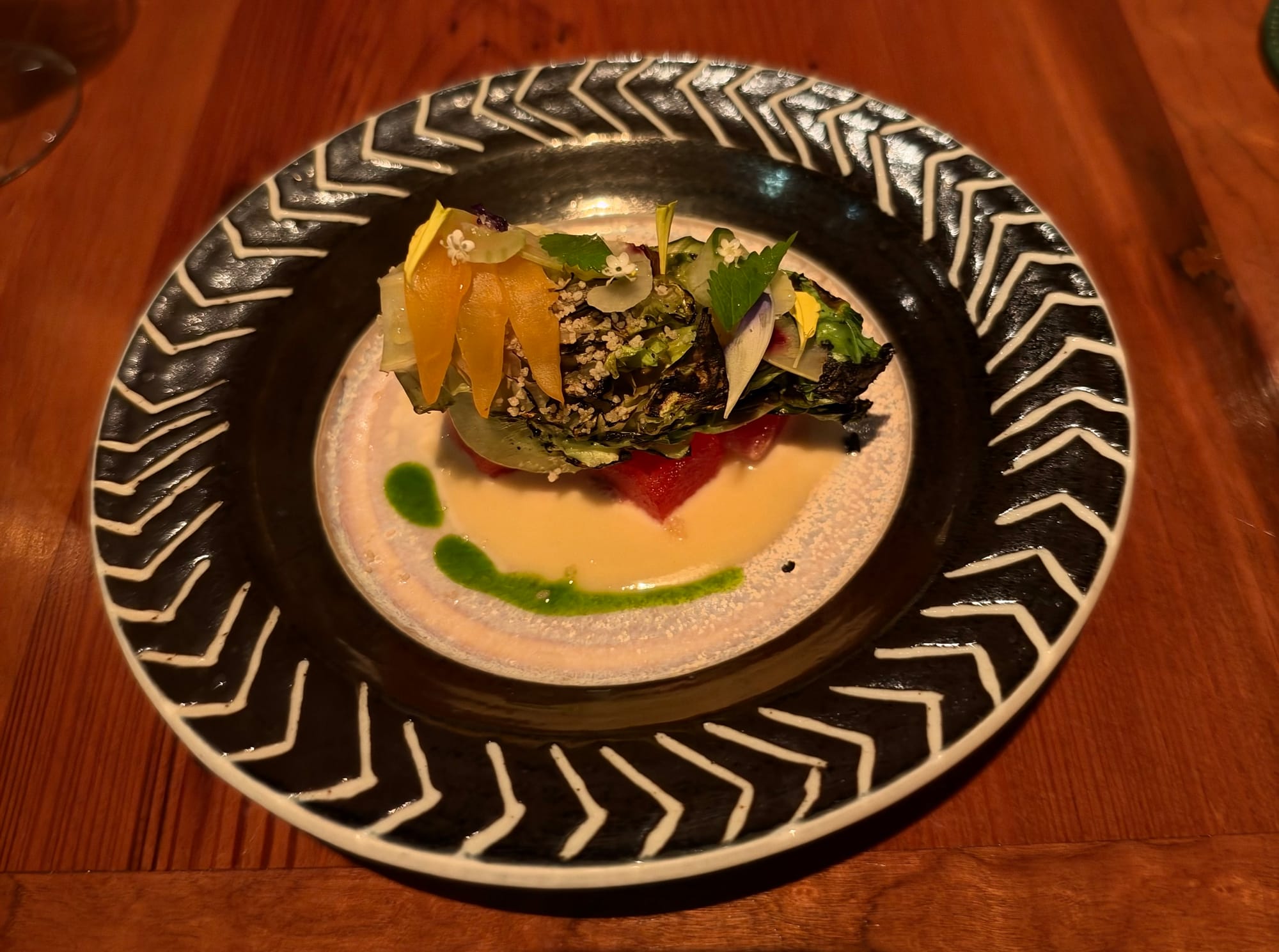
An additional bonus course took the form of a salad of sorts: a grilled Bibb lettuce heart was garnished with Armenian cucumber (which I have just learned is botanically not actually a cucumber, but a melon! Oh, those tricky Yerevantsi taxonomists), compressed watermelon, and local herbs. The greenery had a lovely crunch to it, and the melon (the pink one) added some pleasant sweetness. Side note: why does it feel like watermelon is always compressed when found in composed dishes? I suppose it's because the flavor is more intense, but personally I don't think there's anything wrong with expanded (i.e. normal) watermelon.
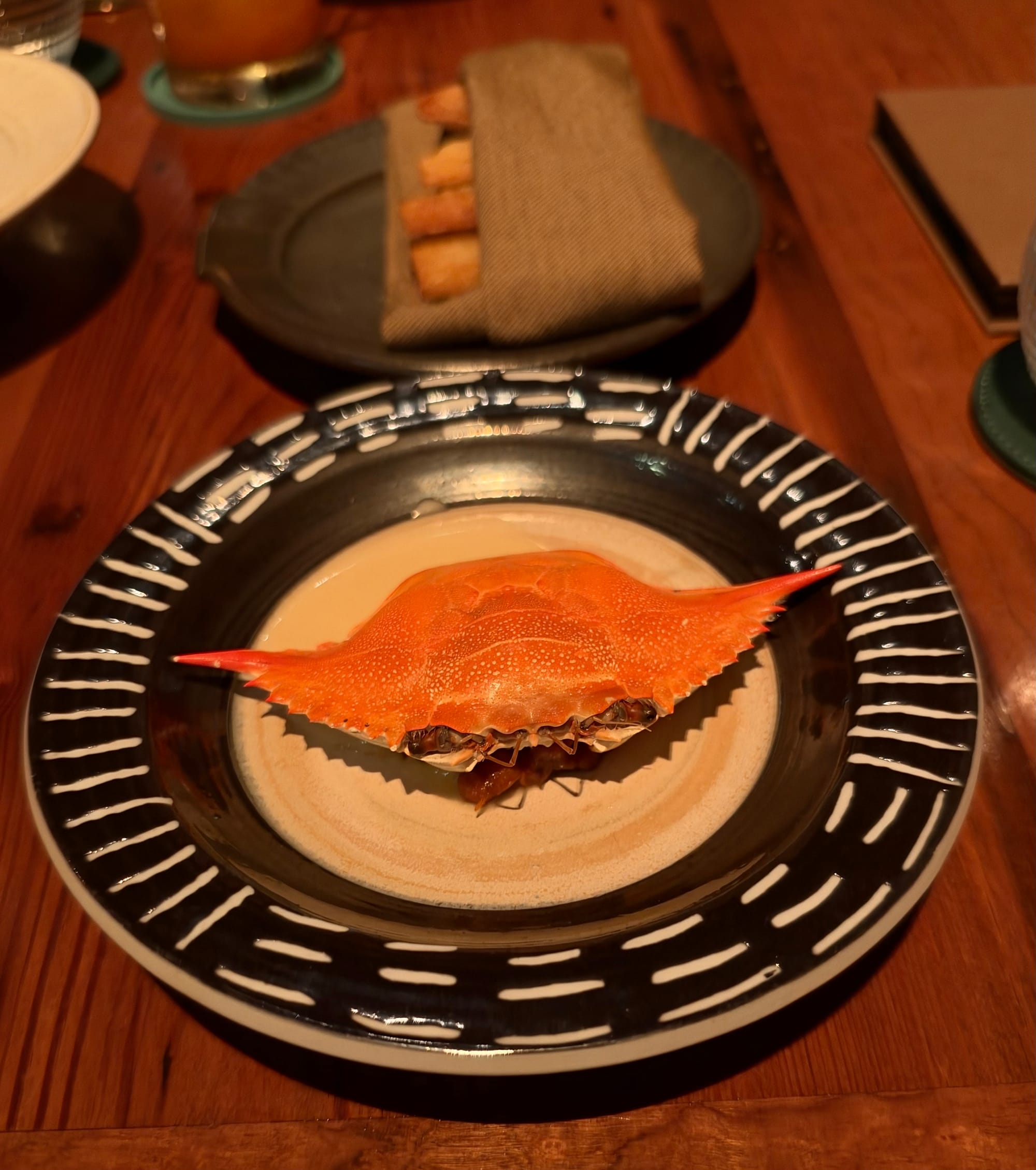
Moving on to the more substantial dishes, we come to Nambé, their take on a traditional Senegalese black-eye pea stew. Most of the dishes on the menu come with some sort of little descriptor, many of which curiously use the legalese term "wherein" (this one quips: wherein the traditional New Year's luck dish wins the lottery). And win the lottery this did, because it was tremendous: an impressive, hollowed-out orange crustacean carapace cloche hid those aforementioned, reduced black-eyed peas with Gulf crab chunks, tomato, and a drizzle of crab jus. This combination was delicious enough on its own, with the savory, earthy beans contrasting with the sweet decapod, but it became even more amazing when heaped on top of the truly extraordinary cassava fritters that came on the side. These were puffy and steaming hot, a bit nutty but just a perfect base for the stew. These fritters had me Hypnotized and might have been my single favorite item of the entire night, though there was a lot of competition for that honor.
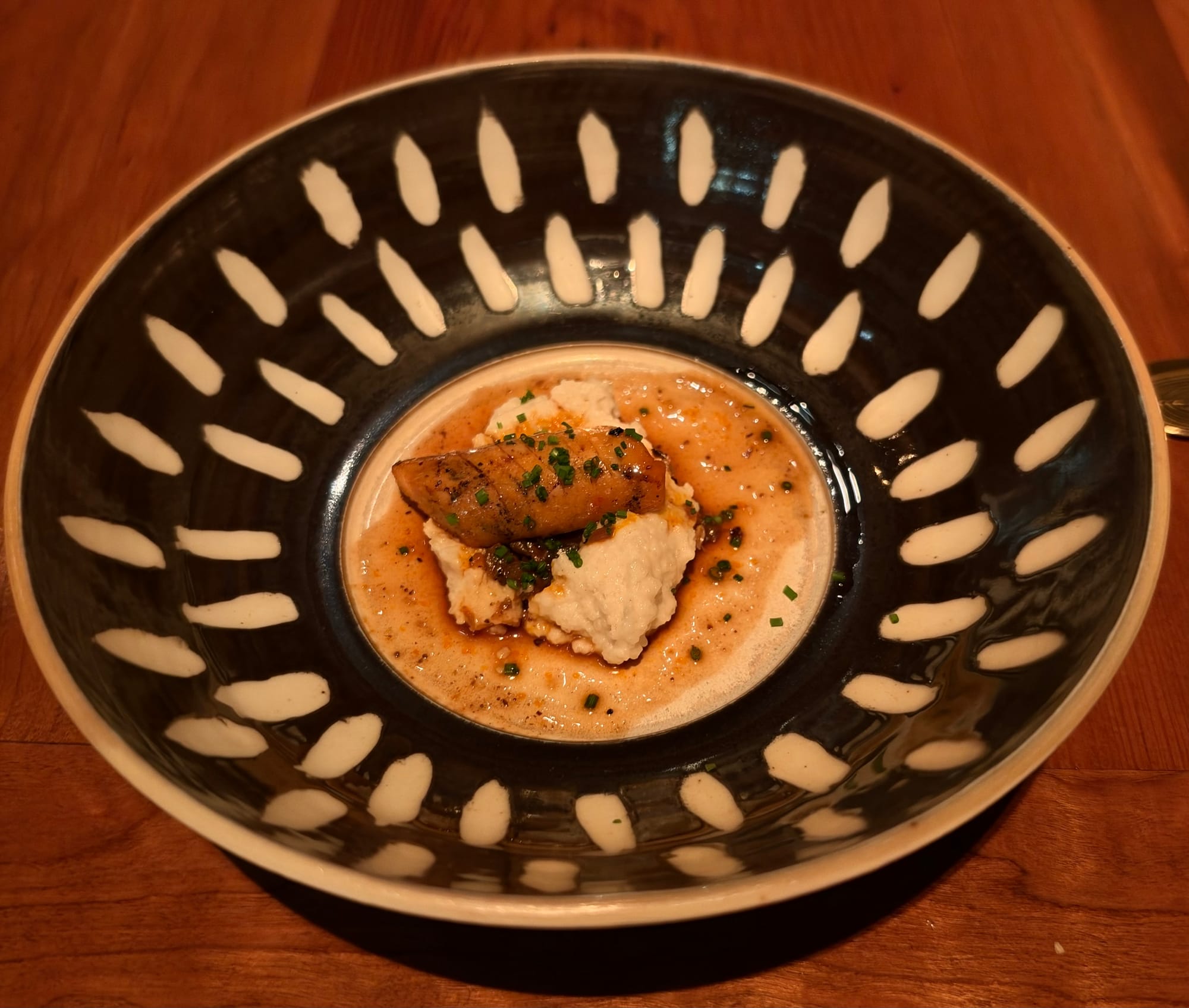
Chef really leaned into the Afro-Cajun fusion with his Seafood Sausage & Grits, where fonio, an ancient grain from Mama Africa, took the place of the southern porridge, and a spectacular, juicy sausage of Gulf shrimp and redfish made up the protein component. A rich, smothered okra sauce tipped the scales more toward Louisiana than Senegal for a moment. Grits are not something I often eat due to the... gritty texture, but the fonio was a bit more smooth and appealing to me. The sausage wasn't fishy at all, the synthesis of the prawn and red drum in the perfect ratio where neither one overpowered the other. This is the kind of dish where creativity really shines through... I was Blown Away, and I've never had anything quite like it.
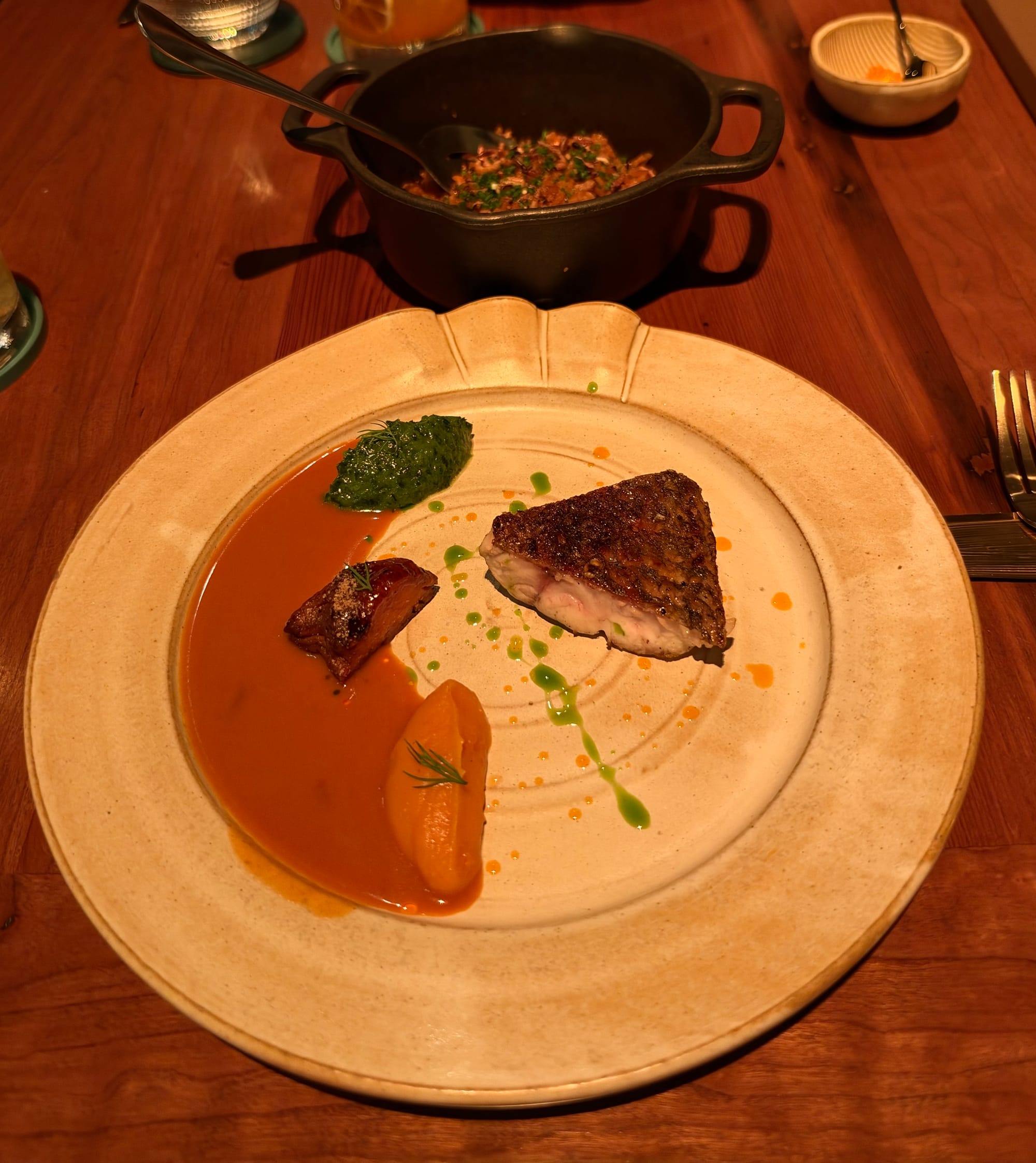
The main event had two parts. Wolof Jollof was described as the "chef's rendition of the rice that conquered west Africa and the world", and Jën "the Gulf's freshest fish, the garden's best bounty, the tangy scent of tamarind". Together they made up a deconstructed version of ceebu jën (or thieboudienne), Senegal's national dish, a fish and rice number recognized by UNESCO as having intangible cultural heritage (ICH), which I am just now learning is a thing (as opposed to the more widely-known tangible cultural heritage sites). A triangular filet of seared redfish with ultra-crispy skin (we're talking Crème brûlée crackly) was served with sweet potato prepared two ways, pureed and grilled with an allium glaze, and Rof, a coarsely chopped green condiment of parsley, scallions, garlic, and citrus. The Jollof rice was, as it always is, fragrant and well-seasoned, with strong tomato and curry powder notes. But the best part was a small side bowl of glowing orange Dakar sauce, a optional infusion of habanero, honey, and oil that the server ominously warned us to add only in small quantities because it was so spicy that it was Dangerous. Needless to say, I completely ignored that advice, as I live for the burn... but he wasn't kidding! This was fiery as hell, but so so good, and it made for an absolutely incredible bite when combined with the other components.
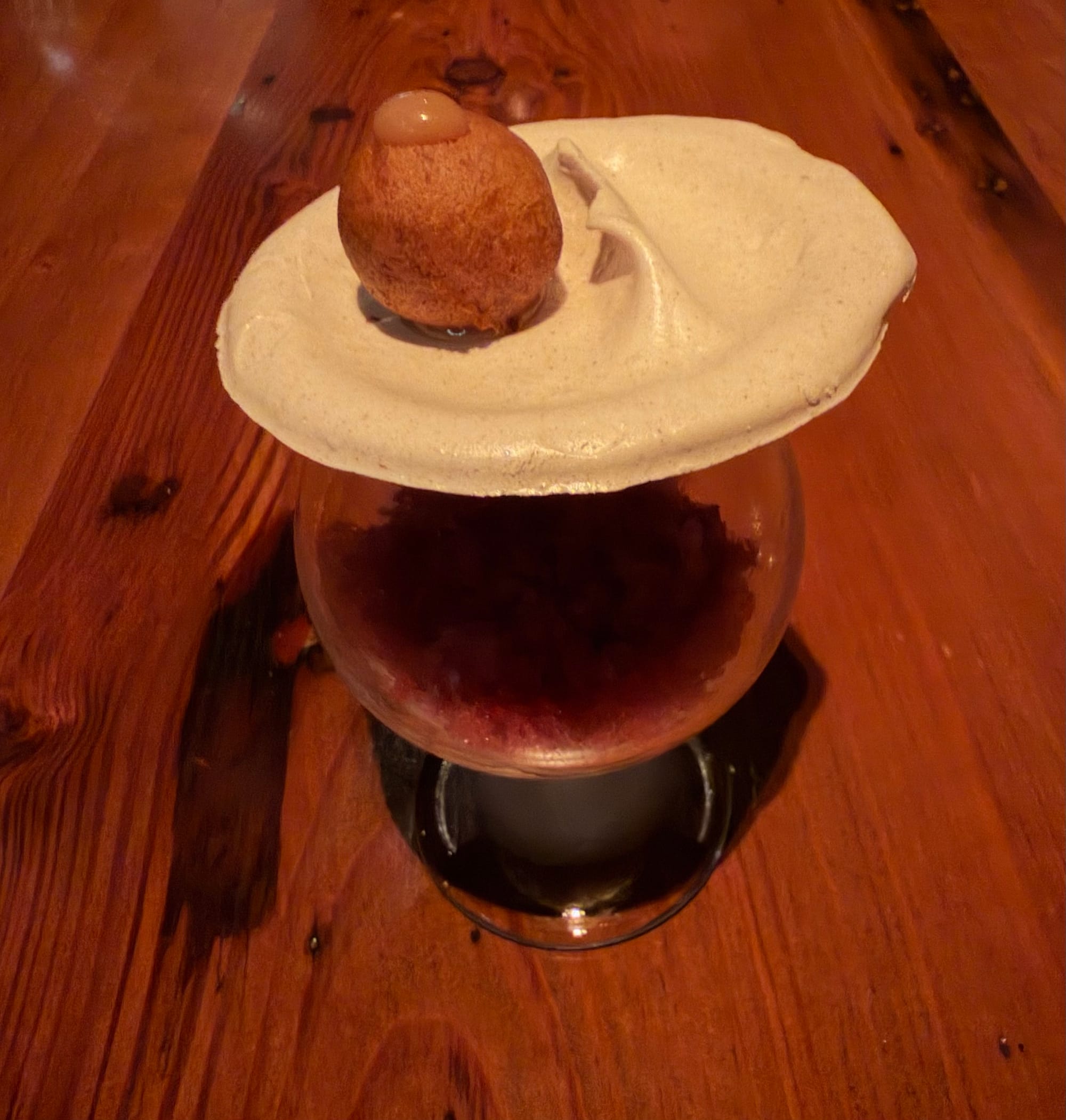
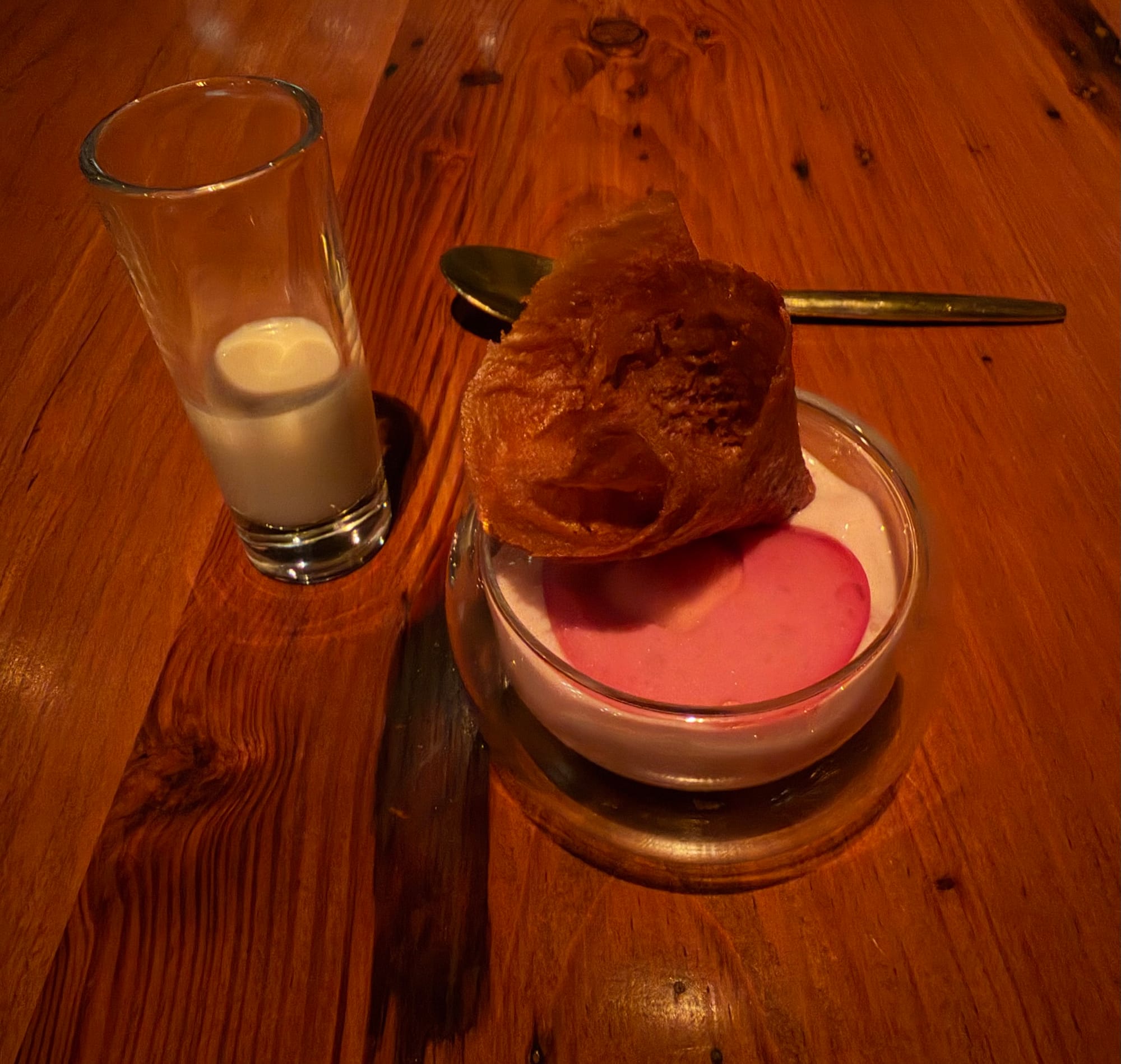
A quick palate cleanser had a caramel-adorned puff-puff (amongst my favorite types of fried doughs), vanilla cardamom meringue, and hibiscus granita. It was kind of fun to Smack That stiff whipped egg topper with a spoon until it cracked into the Frozen, floral granules beneath. That was a nice transition to dessert, the concluding course called Tigernut Float: "wherein (again with the wherein, did Ruth Bader Ginsburg write this menu or something?) dates become gooey gooey cake, and tiger nut tubers become frozen yogurt and foam". Tiger nuts (aka earth almonds) are the edible tubers of the Cyperus esculentus plant, and are another ingredient that I had never experienced before (which is one of the most fun parts of exploring unfamiliar cuisines). This preparation included sticky toffee pudding-esque date cake at the bottom of a glass cup, topped with the nutty, tiger nut-derived frozen yogurt, and accompanied by a shot glass maybe one-third full of foamy goodness from the same source. Quite unusual, but a fitting end to the night.
I'm not sure if my words adequately capture how excellent this dinner was (I know I have shortcomings as a writer... Sorry, Blame It On Me): it was unquestionably one of the ten best meals I've had in my life. So unique, so innovative, and so tasty, I almost didn't notice that there wasn't any meat to be found. I was getting ready to rant about my recent frustration with the Michelin Guide (don't worry, that's coming next week), but literally between the time I ate here and the time of publication of this review, Dakar NOLA received a newly-awarded Michelin star! So at least something is right in the world. It's not the easiest place to get a reservation, but if you find yourself in New Orleans and want a change of pace from the multitude of awesome Creole restaurants, I highly recommend giving this a try. I Can't Wait to go back. If every restaurant in Akon City was this good, I would move to Senegal Right Now.
RANKING UPDATE: I never thought this would be the case, but Dakar NOLA has Locked Up the New Orleans spot on my Beyond Houston guide (a very heartfelt apology to my beloved Commander's Palace). Which brings me to the unveiling of my top New Orleans restaurants list, which might be the last new city bar/restaurant rankings I debut for quite some time...
New Orleans Restaurant Rankings:
- Dakar NOLA
- Commander's Palace
- GW Fins
- Turkey And The Wolf
- LUFU NOLA
- Mr. B's Bistro
- Galatoire's
- Antoine's
NEXT UP: Some pointed comments about the state of the Texas Michelin Guide, before a review of one they got right.